⚡ CurbsideALXCurbside EV Charging · Alexandria, Virginia
Independent proposal prepared by an Alexandria resident — not an official City of Alexandria publication.

Appendix

The signs we've posted

Enabling curbside charging hasn't only been a research project — it's been a running standoff with a neighbor. Over the summer, more than a dozen Alex311 reports were filed about one covered charging cable outside 1 W Oak Street. These are the signs we've posted in response, in order. The blow-by-blow record of the reports themselves is in the Scofflaw Dossier.
Preview of the open-letter sign
Sign One · June

The open letter 1 page

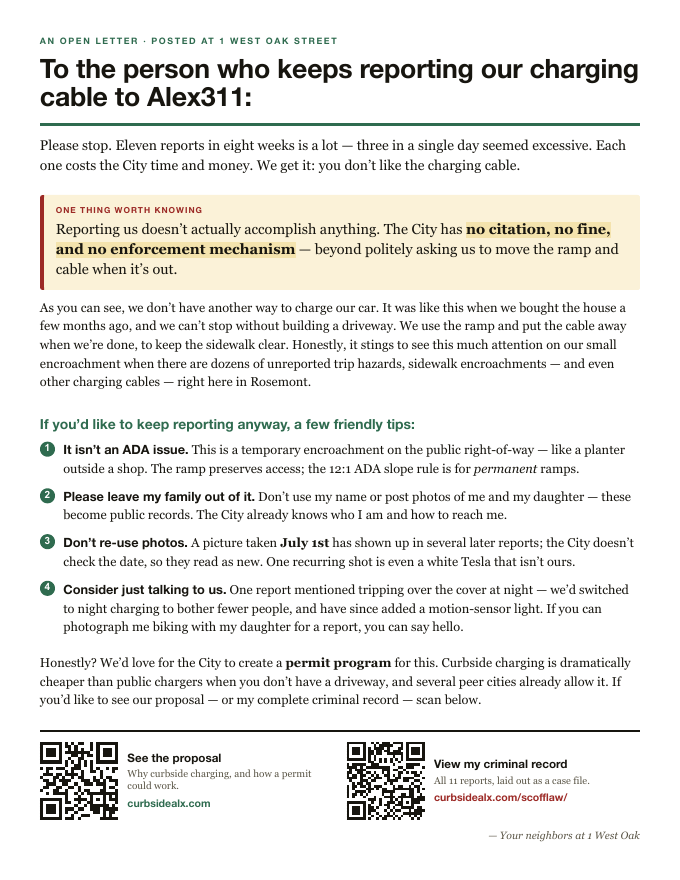
A direct, good-faith note to whoever kept filing: please stop, here's why we can't simply quit (no driveway), what we already do to keep the sidewalk clear, and the permit fix we're working on. The line about there being no citation, no fine and no enforcement mechanism was not a taunt at the City — it was what City staff had told us, and the sign says so in the same breath as noting that the City had asked us to move the cable. At a later meeting we were told that a penalty was available after all. The sign didn't stop the reports either; one of them submitted a photo of this very sign as evidence.

Download PDF
Preview of the fine-warning and vote-board signs
Sign Two · after the reports continued

The fine warning & vote board 3 pages

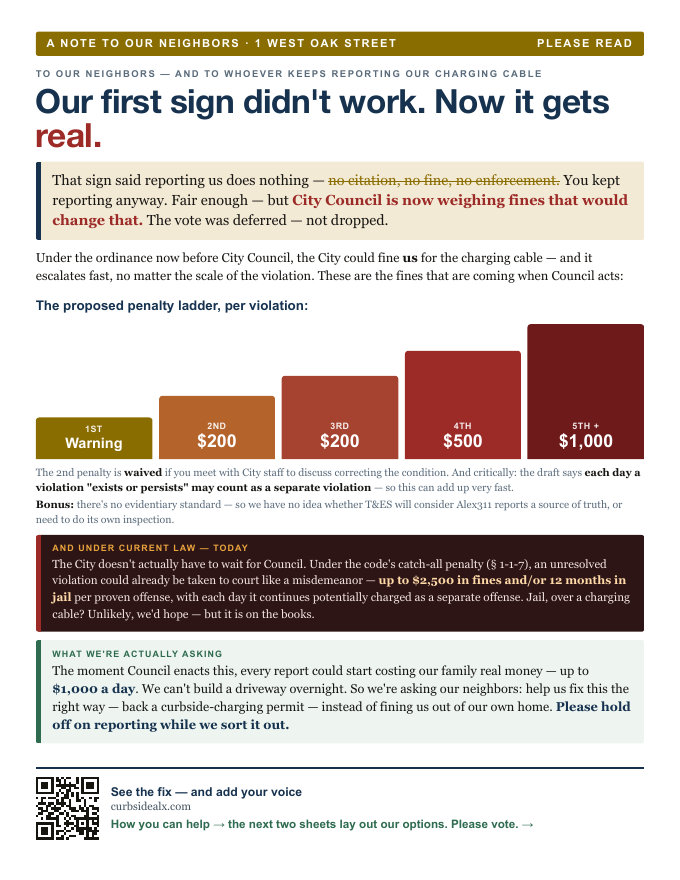
Sheet one explains what's pending: Council is weighing amendments to the right-of-way code (§§ 5-2-16 & 5-2-29) that would add an escalating civil penalty — warning, $200, $200, $500, then $1,000, with each day potentially a separate violation. The vote was deferred — not dropped; these are the fines that are coming when Council acts. The sheet also notes the current-law backdrop: under the code's catch-all penalty (§ 1-1-7), an unresolved violation could already be taken to court like a misdemeanor today — up to $2,500 and/or 12 months per proven offense (the analysis). Sheets two and three turn it into a neighborhood vote: every realistic alternative to charging at home, and what each one actually costs, against the ~$1,128/yr home-charging baseline.

Download PDF (3 sheets)
Preview of the reporter comment card
Sign Three · an invitation

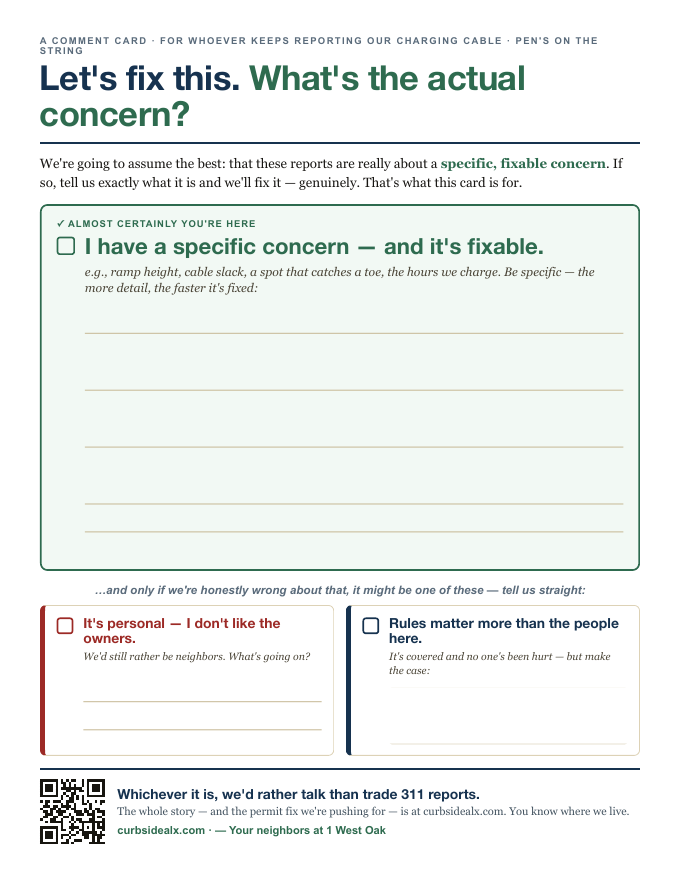
The comment card 1 page

A card for whoever keeps reporting, assuming the best: that it's really about a specific, fixable concern. Check the box, tell us exactly what — ramp height, cable slack, charging hours — and we'll fix it. Two smaller boxes cover the honest alternatives. Whichever it is, we'd rather talk than trade 311 reports.

Download PDF
Preview of the trench-drain solution sign
Sign Four · the exhibit

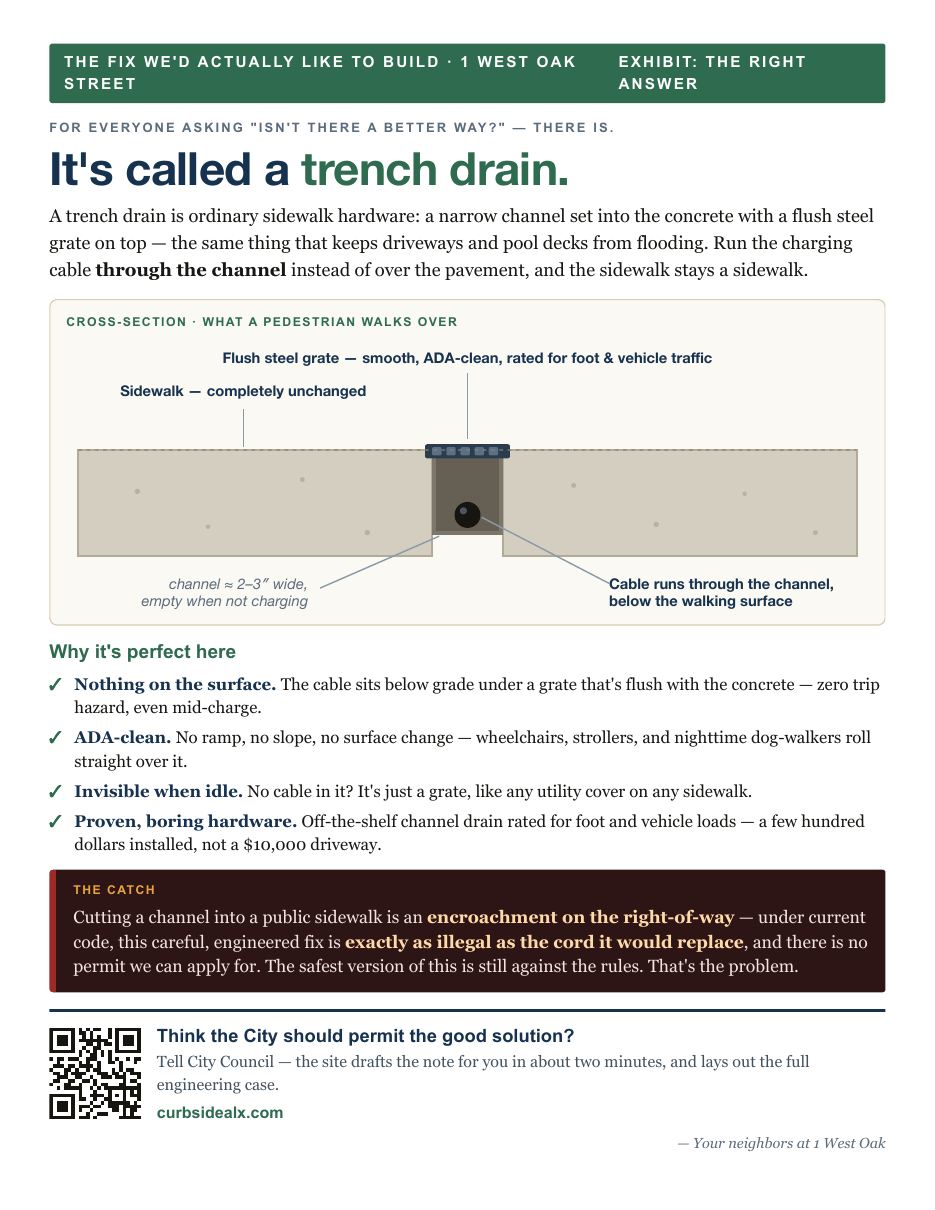
The trench drain 1 page

The fix we'd actually like to build. A trench drain is ordinary sidewalk hardware — a narrow channel set into the concrete with a flush steel grate on top. Run the cable through the channel and there's nothing on the surface at all: no ramp, no trip hazard, ADA-clean, invisible when idle, a few hundred dollars installed. The catch, and the reason this sign exists: cutting that channel is an encroachment on the right-of-way — under current code the engineered fix is exactly as illegal as the cord it would replace, and there's no permit to apply for.

Download PDF
Preview of the voting-results sign
Sign Five · September · the results

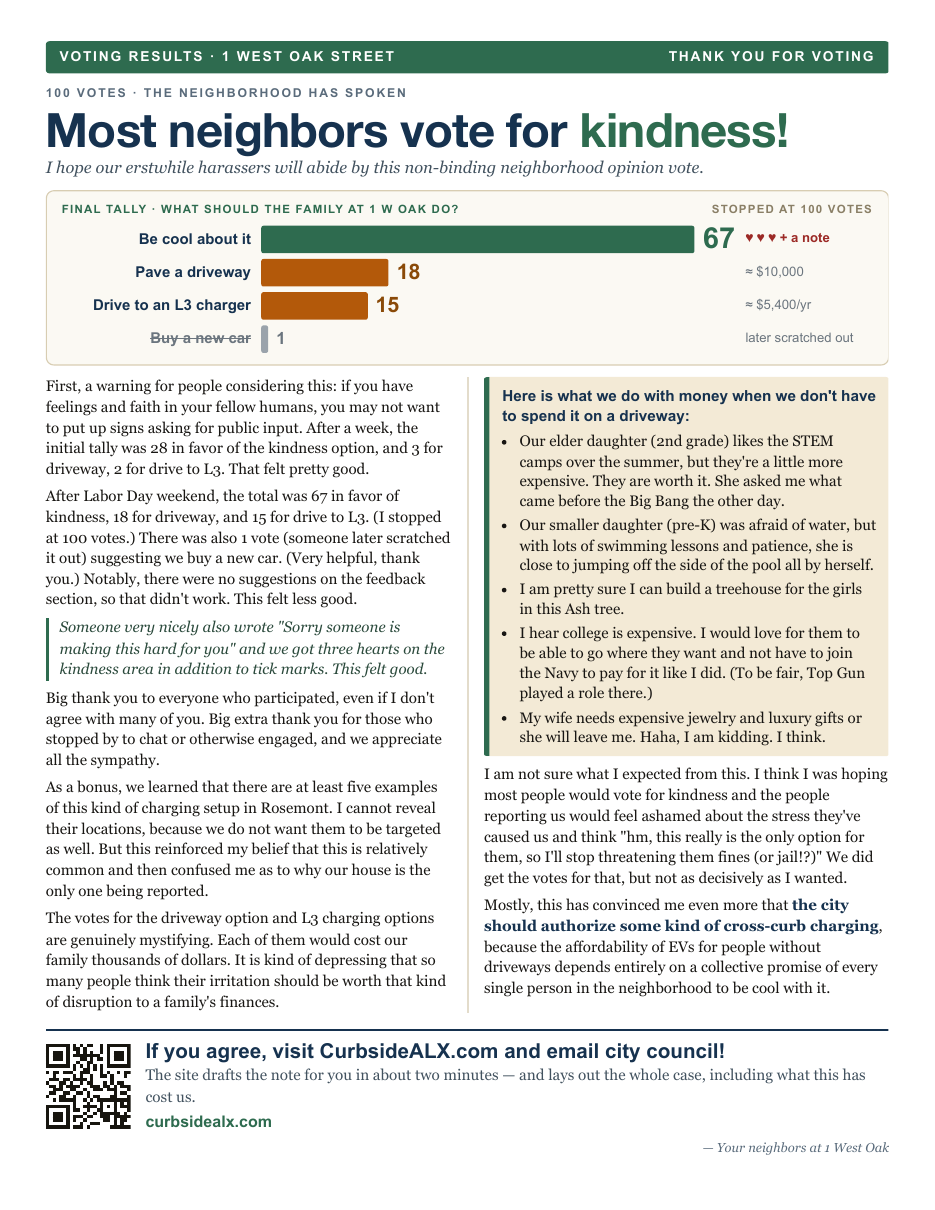
The vote results 1 page

We stopped the vote board at 100 votes. 67 neighbors said be cool about it, 18 said pave a driveway, 15 said drive to an L3 charger, and one suggested we buy a new car (later scratched out). Someone wrote "Sorry someone is making this hard for you," and the kindness column picked up three hearts. Kindness won — but not as decisively as we'd hoped, and roughly a third of the neighborhood was willing to spend thousands of dollars of our family's money to resolve their irritation. That's the whole argument for a permit in one number: the affordability of an EV without a driveway currently depends on every single neighbor choosing to be cool with it.

Download PDF Read the full results →
Preview of the pledge-of-compliance sign
Sign Six · September · compliance

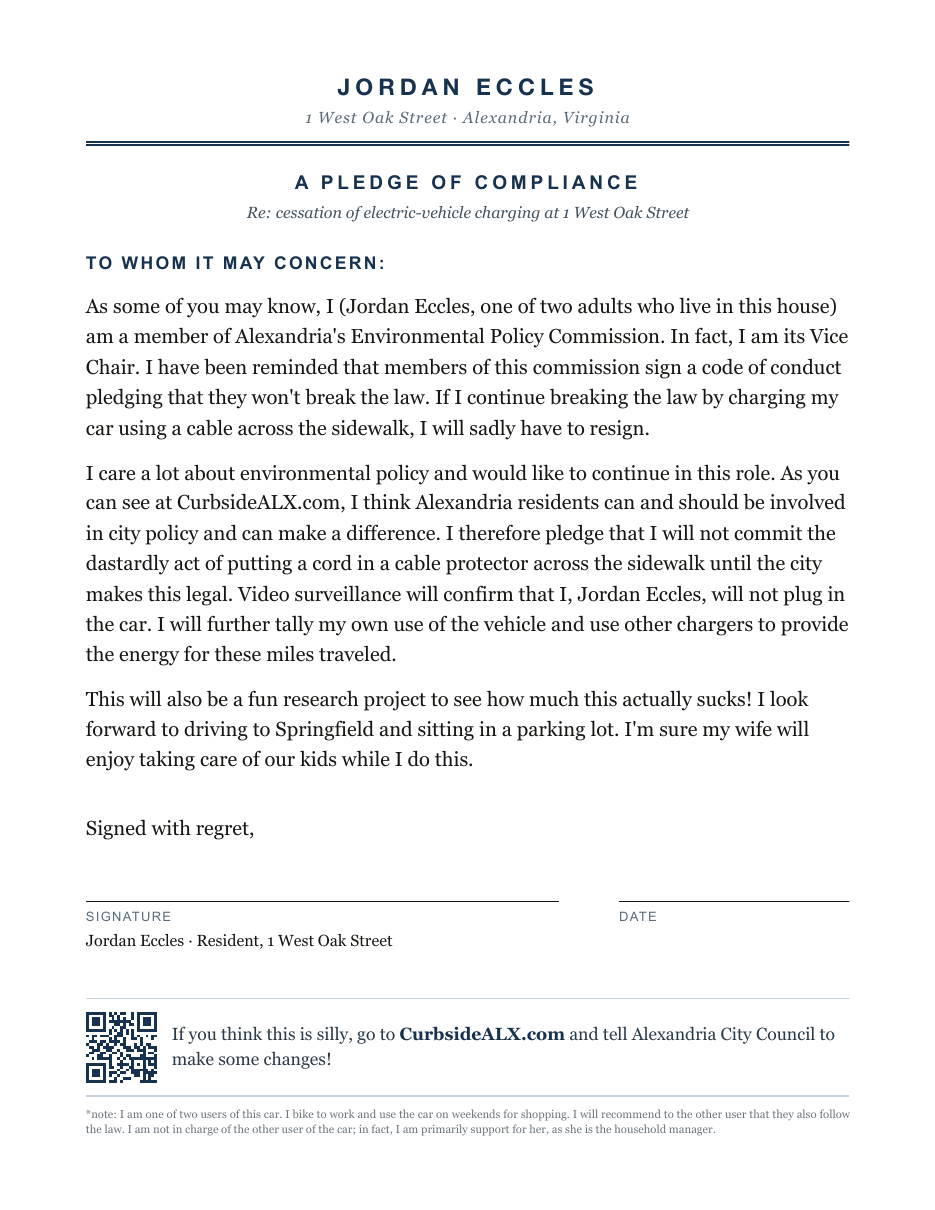
The pledge 1 page

A formal pledge to obey the law, addressed to whom it may concern. The author sits on Alexandria's Environmental Policy Commission — as its Vice Chair — and commission members sign a code of conduct promising not to break the law. So: no more cord in a cable protector until the City makes it legal. Instead, a tally of every mile driven and a trip to a parking lot in Springfield to charge, described as "a fun research project to see how much this actually sucks." Signature and date lines included. The joke is the point — obeying this particular law costs a household real money and real evenings, and there is no legal way to comply that doesn't.

Download PDF
Preview of the supercharger field-test sign
Sign Seven · September · the field test

The supercharger test 1 page

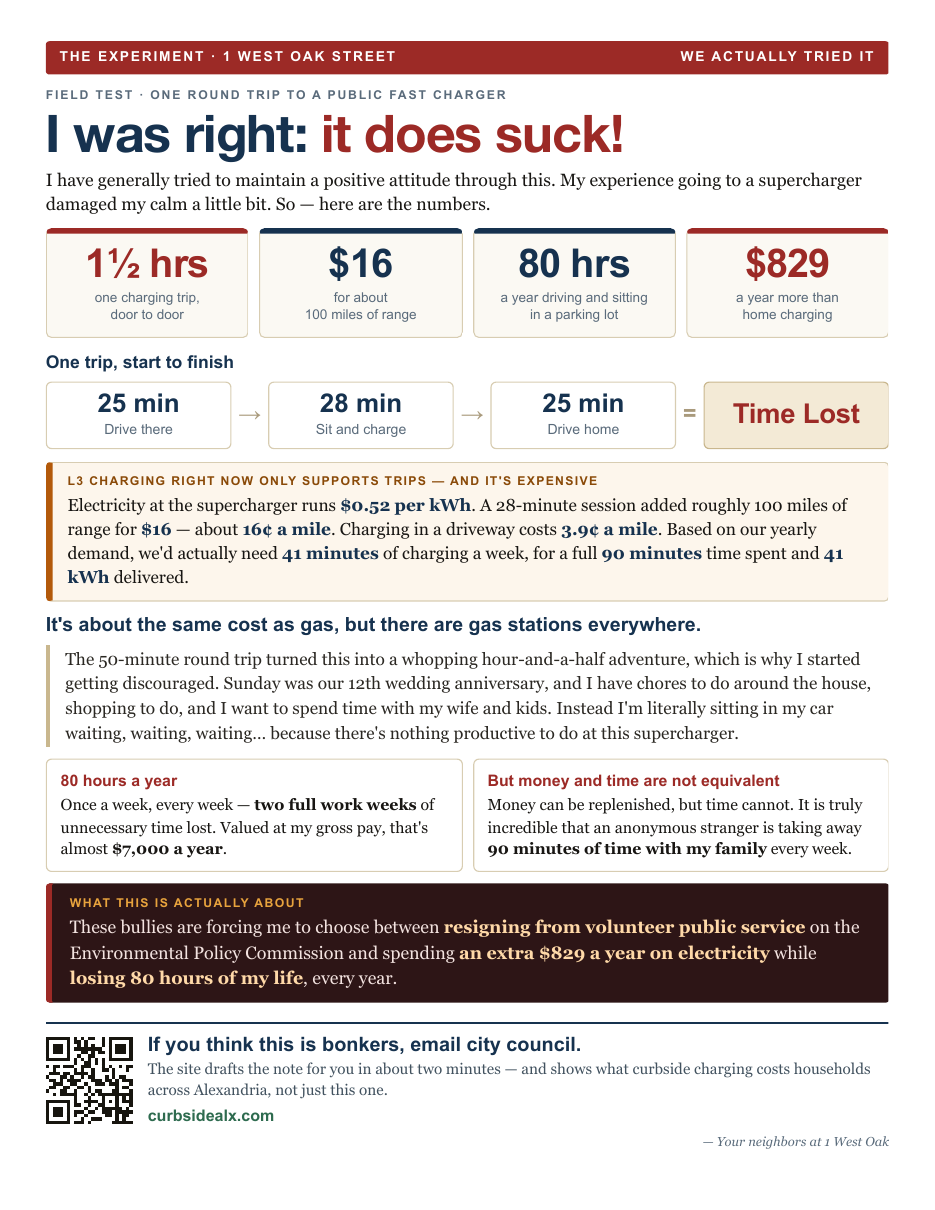
Having pledged to stop charging at home, we went and did the alternative — properly timed and metered. One round trip: 25 minutes there, 28 minutes charging, 25 minutes back, for about 100 miles of range at $16. That is 16¢ a mile against 3.9¢ in a driveway, and 90 minutes of a Sunday that happened to be a wedding anniversary. At once a week it works out to roughly $829 and 80 hours a year — two full working weeks in a parking lot. The full write-up is here.

Download PDF Read the field test →
Preview of the story-so-far sign, page one
Sign Eight · October

The story so far 2 pages

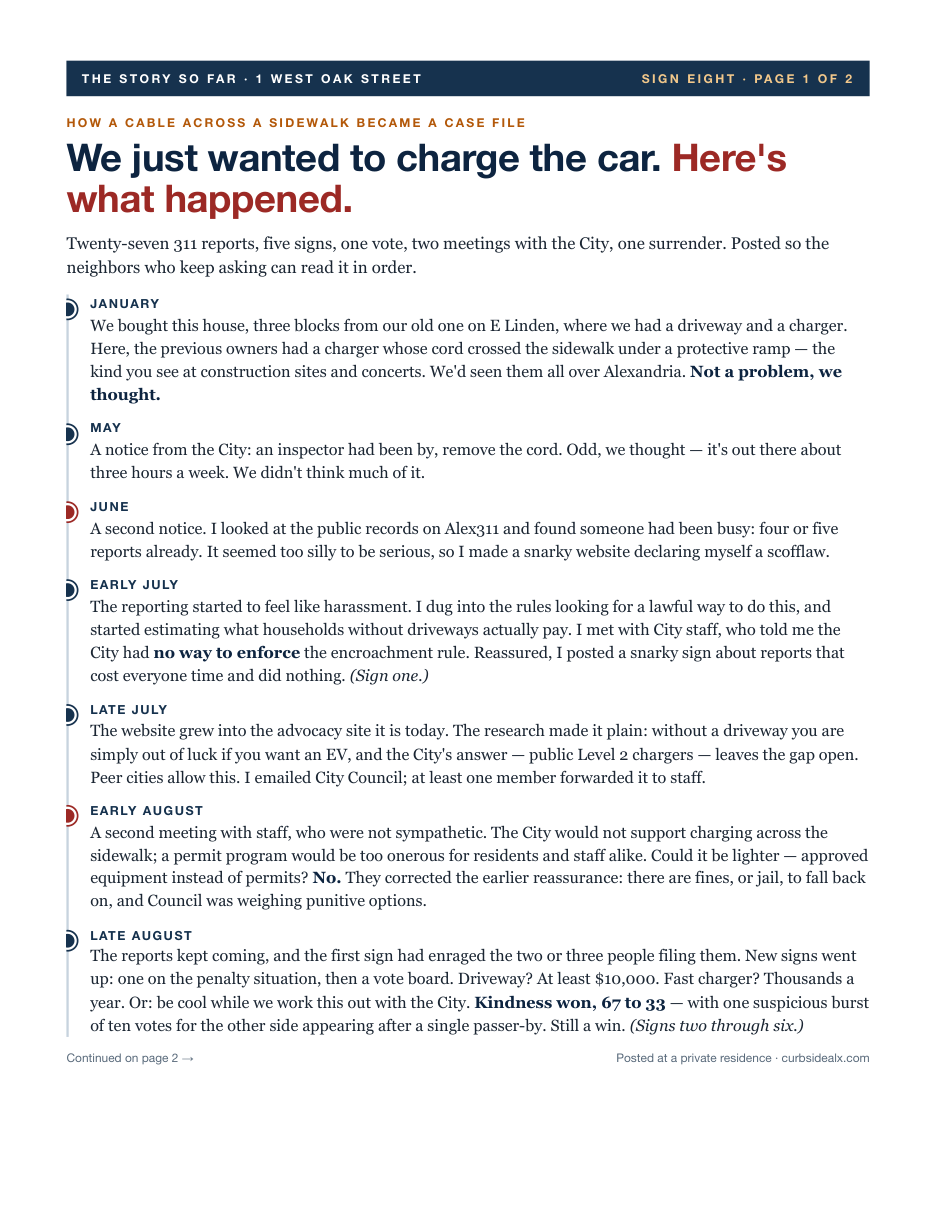
For the neighbors who keep asking: January to October in order, from the house purchase to the notices, the reports, the meetings, the vote, the commission seat, the surrender, and the unanimous EPC letter. Page two ends with three QR codes — the site, the letter to Council (including the new follow-up option), and the reports themselves. The same timeline is online at The Story So Far.

Download PDF (2 pages)
Preview of the CurbsideALX flyer
For shop windows and bulletin boards

The flyer 1 page

The yard sign, reset for a standard 8.5×11 sheet so a store or café can hang it: the same six lines, a QR code to the site, a second one straight to the two-minute letter to Council, and a short note on why it matters. If you'd like to post one, print it — and thank you.

Download the flyer
Print the whole set

All eight signs in posting order behind a cover sheet — twelve pages, formatted for 8.5×11. Print, and slip outdoor copies in a sheet protector.

Download full packet (12 pages)

Signs prepared July–September 2026 for posting at a private residence. One report's photo is deliberately withheld from the public record pending redaction of an image of a minor.