Research · Safety & Accessibility
Selecting an appropriate cable protection standard
If Alexandria permits temporary residential EV charging cables to cross a public sidewalk, what engineering standard should apply to the protective cable cover? The answer already exists in the City's and the Commonwealth's own practice: evaluate it as a temporary pedestrian facility, not as permanent ADA infrastructure.
Key finding
The ADA framework, VDOT's Work Zone Pedestrian and Bicycle Guidance, and Alexandria's own Maintenance-of-Traffic policy all evaluate temporary pedestrian facilities under a different, practicability-based standard than permanent construction. A cable protector that exists only during charging belongs in that framework. This is not an argument to ignore accessibility — it is an argument to apply the engineering standard that is actually designed for temporary conditions.
A temporary crossing, not permanent infrastructure
A temporary cable protector is not a permanent feature of the pedestrian network. It is deployed only while a vehicle is charging, then removed. Its purpose is to enclose the charging cable, reduce trip hazards, and provide a stable walking surface over a localized, temporary obstruction. Under the proposed permit, the protector would typically be present for a few hours at a time, a few times a week — and absent the rest of the time.
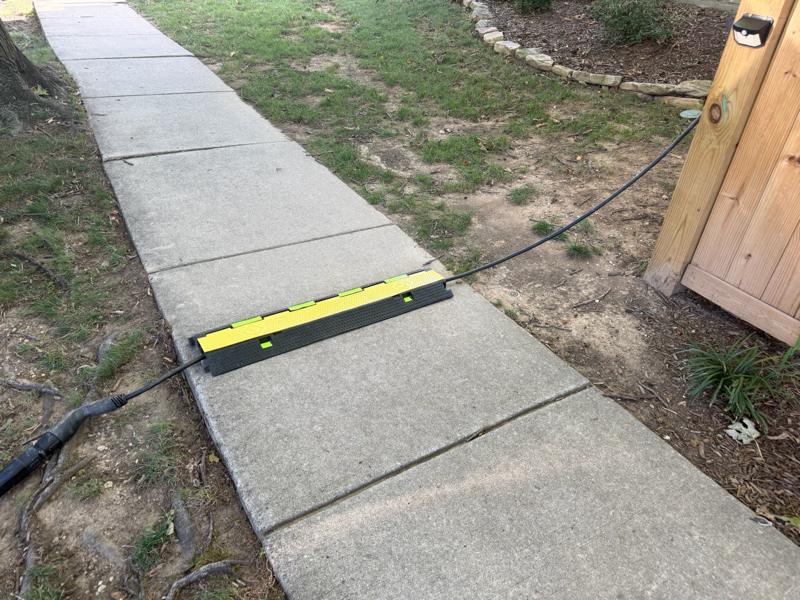
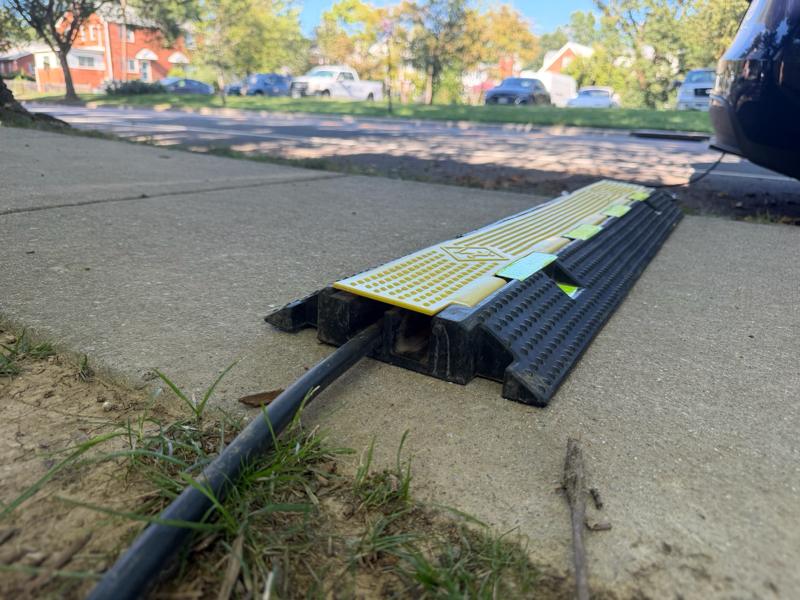
The device pictured is an off-the-shelf commercial pedestrian cable protector of the kind the proposed standard would whitelist. Night and removed-condition photos will be added.
Responding to the one complaint that described an incident
Of the twenty-seven 311 filings about this crossing, exactly one describes something that actually happened: a neighbor reported tripping while walking dogs after dark, noting the street was poorly lit. That is a specific, fixable complaint, and it was fixed. Retroreflective tape now runs along the protector's lid and edges, so it returns light from a phone torch, a headlight, or a porch lamp, and a solar-powered LED floodlight mounted on the fence post above the cable route illuminates the crossing after dusk. Both are visible in the photographs above. Neither was required by any rule — which is the point: a published standard should require them, so that night visibility does not depend on whether an individual resident happens to think of it. See what the 311 record actually says for the full corpus.
Commercial pedestrian cable protectors are purpose-built for exactly this scenario. They are used routinely wherever cables must cross walking routes in public environments: convention centers, stadiums, schools, warehouses, festivals, and outdoor events. They are removable, slip-resistant, highly visible, and designed for repeated deployment under pedestrian and cart traffic.
Temporary facilities are evaluated differently — by design
The ADA framework distinguishes between permanent accessible infrastructure and temporary pedestrian facilities. The U.S. Access Board's guidance for work in the public right-of-way recognizes that temporary facilities may be constrained by existing conditions and requires accessibility "to the maximum extent practicable," rather than requiring every temporary condition to replicate permanent construction.
VDOT's Work Zone Pedestrian and Bicycle Guidance (2016) applies the same principle: where physical constraints make full compliance impracticable, compliance is required to the maximum extent practicable, with the constraints documented. The emphasis is on maintaining an accessible pedestrian route — not on requiring every temporary object within that route to satisfy the geometric criteria for permanent curb ramps.
The same VDOT guidance illustrates how different the temporary framework is in practice: temporary curb ramps in work zones may have slopes up to approximately 12 percent (about 1:8), substantially steeper than the 1:12 slope associated with permanent ADA ramps.
Read carefully
The work-zone ramp geometry is an example, not the proposed standard. The point is not that cable protectors should be built like construction ramps. The point is that temporary pedestrian facilities have long been evaluated under a different regulatory framework than permanent sidewalk construction — so evaluating a removable cable protector against permanent-curb-ramp criteria applies the wrong test.
What happens when the wrong test is applied: Washington, DC
The District of Columbia provides a live demonstration of why the distinction matters. DDOT's 2022 cross-sidewalk charging guidance — commendably — allows residents to charge without a permit, but it derived its cable-cover geometry from ADA provisions written for permanent construction. Covers under half an inch tall may use the 1:2 bevel that ADA §303.3 allows for small changes in level; anything taller is treated under the standard for permanent ramps: 1:12 slopes plus five-foot level platforms. For the one-inch covers that commercial products actually are, that implies roughly seven feet of structure to cross a one-inch cable.
The documented result (Roodman, Greater Greater Washington, 2026): no product on the market satisfies the taller-cover standard, residents cannot practically comply, and observed compliance in DC neighborhoods is near zero — most residents simply use whatever cover they find online, at whatever geometry. When the author consulted the U.S. Access Board, an engineer confirmed that the current ADA standards do not directly address cables; DDOT had adapted rules intended for other situations. A standard borrowed from permanent infrastructure thus produced neither accessibility nor compliance — while a performance-based temporary-facility standard (stable, slip-resistant, visible, traversable, removable) describes equipment residents can actually buy and cities can actually inspect.
Alexandria already uses this approach
Alexandria's 2018 Memorandum to Industry No. 04-18 (Maintenance of Traffic Plans — Maintaining Access for Pedestrians and Bicyclists During Construction) takes the same practicability-based approach for temporary encroachments: it requires protected pedestrian access adjacent to construction whenever possible, encourages temporary pedestrian facilities, and requires temporary ramps where temporary elevation changes occur. Rather than prohibiting temporary objects within the sidewalk, the City's policy relies on engineering judgment to maintain safe and accessible pedestrian travel.
The City also has a general legal framework for objects in the right-of-way: Alexandria Code §5-2-29 (street encroachments). The permit proposed here would sit within that existing structure — a revocable authorization with conditions — rather than requiring new legal machinery.
The right question for T&ES review
The appropriate question for an approved-equipment list is therefore: does this device provide a reasonably safe, stable, visible temporary pedestrian crossing while preserving sidewalk access? Performance criteria that follow from this framing:
| Goal | What it means in practice |
|---|---|
| Stable | Does not shift, rock, or migrate under foot traffic; lies flat on the walking surface. |
| Slip-resistant | Textured tread surface performing in wet and dry conditions. |
| Visible | High-contrast color (typically safety yellow), detectable in daylight and under street lighting. |
| Low-profile, gradual edges | Beveled approach angles that a pedestrian, wheelchair, or stroller can traverse without abrupt vertical faces. |
| Protects the cable | Fully encloses the cord; rated for pedestrian loads. |
| Removable | Deployed only while charging; stored on private property otherwise. |
These are the criteria detailed in Proposed Engineering Standards. They regulate the outcome — safe, accessible pedestrian passage — using the framework the City already applies to every other temporary condition on its sidewalks. The ramp is also the near-term baseline rather than the only answer: a flush recessed cable channel is the permanent alternative, compared in Crossing Options & Costs.
Sources
- U.S. Access Board, ADA Standards for Accessible Design (2010) and Public Rights-of-Way guidance (temporary facilities; "maximum extent practicable").
- Virginia Department of Transportation, Work Zone Pedestrian and Bicycle Guidance (2016).
- City of Alexandria, Memorandum to Industry No. 04-18: Maintenance of Traffic Plans — Maintaining Access for Pedestrians and Bicyclists During Construction (2018).
- City of Alexandria Code §5-2-29 (Street Encroachments).
- David Roodman, The Long, Winding Journey to Safely — and Legally — Charging My DC Street-Parked EV, Greater Greater Washington, February 11, 2026.