Research · Crossing Technology · September 2026
Why a ramp — and what comes after it
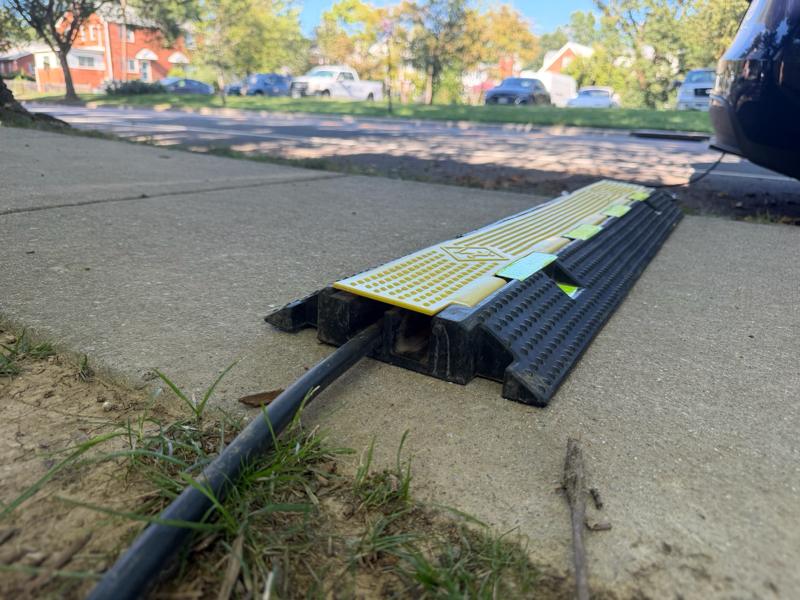
The only physical question in this whole proposal is how a charging cable gets from a house to a curbside car across three or four feet of public sidewalk. Four technologies can do it. They are not equivalent: the removable cable ramp is the lowest-cost option available today, the recessed cable channel ("gully") is the strongest permanent option because it sits flush with the walking surface, overhead arms trade excavation for structural and visual problems, and ultra-flat cables are promising but not yet certified in the U.S.
The four options, compared
| Option | Crossing-only startup cost | Recurring cost | Readiness | Working assessment |
|---|---|---|---|---|
| Removable ramp / cable cover | ~$300 device; permit or insurance may add cost | Possible permit/insurance renewal | Available now | Best low-cost near-term option — and the proposal's baseline |
| Recessed channel / gully | ~$1,250–$2,250; central ~$1,750 | Inspection/maintenance, policy-dependent | Mature overseas; U.S. approval pathway needed | Best permanent option — flush surface, no recurring ramp |
| Overhead cable arm | Highly site-specific; garage arms ~$299, a robust right-of-way system uncertain | Moving parts, inspection, maintenance | Products exist; little municipal practice | Generally inferior default — structural, clearance, visual, and review issues |
| Ultra-flat charging cable | ~$399 extension / ~$599 portable product | None beyond cable replacement | U.S. certification (UL/CSA/ETL) pending | Promising future option, not a policy baseline |
Why the ramp is the baseline
The removable protector is the proposal's default for three reasons that hold regardless of what comes later. It costs hundreds of dollars, not thousands, so it keeps the incremental cost of charging access in reach of any household that already has an EVSE. It requires no saw cut, no utility marking, and no restoration — nothing in the sidewalk changes. And because it is present only while charging, it is evaluated under the temporary-pedestrian-facility framework the City already applies to every other short-lived condition on its sidewalks. The open policy questions for a ramp are accessibility profile, placement, and maintenance — not construction. That makes it both a permanent answer where a compliant device is acceptable and the interim answer while anything more permanent is worked out.
The permanent option: a recessed cable channel
In the United Kingdom, where cross-pavement charging is now national guidance, embedded cable channels are the most common solution: a narrow channel is cut into the pavement, the cable is dropped in only while charging, and the top surface stays substantially flush — no ramp on the sidewalk, ever. Published UK programs install one in roughly 1.5–3 hours at about £1,000–£1,650 all-in; supply-only hardware starts around £379–£449.
The cost question for Alexandria is not how much concrete comes out. A standard pedestrian sidewalk here is 4 inches thick (6 inches only in driveways), and the crossing is 3–4 feet long. That is why generic trench-drain per-foot pricing — meant for long runs along garages and loading docks — is a poor guide. For one short cut, mobilization, saw cutting, careful restoration, permitting, inspection, and the channel hardware itself dominate, not material volume.
| Component | Low | Central | High | Basis / caveat |
|---|---|---|---|---|
| Channel hardware / specialty materials | $500 | $650 | $850 | Planning allowance informed by UK supply-only pricing; not a U.S. quote |
| Saw cut, excavation, bedding, installation, restoration | $450 | $700 | $1,000 | Small concrete job; mobilization likely dominates; no Alexandria contractor quote yet |
| T&ES excavation permit | $250 | $250 | $250 | Current published fee per city block |
| Drawing / minor MOT / admin allowance | $50 | $100 | $150 | Policy-dependent |
| Estimated crossing-only total | $1,250 | $1,700 | $2,250 | Excludes EVSE and any unusual utility conflict; rounded to ~$1,750 for modeling |
A local reasonableness check: a permitted curb cut through the City contractor runs about $3,000. A channel needs less physical work (no curb-and-gutter reconstruction, no vehicular apron), but the saving won't be proportional to the smaller concrete quantity, because mobilization, pedestrian protection, inspection, and administration remain.
A planning estimate, not a bid
The range assumes ordinary concrete sidewalk with no major utility conflict, no historic brick to lift and relay, no tree-root conflict, no full-panel replacement, and no electrical-panel work. Any of those — or a City-required proprietary product, special inspection, sidewalk-closure plan, or annual licensing fee — moves the number up. The most valuable next step is not another national survey; it is a unit price from Alexandria's existing sidewalk contractor for a standard 3–4-foot channel, individually and in batches of 10, 25, and 50, since mobilization is the swing factor. A pilot of five to ten installations would answer the rest.
For lifecycle comparisons, amortize the channel over a conservative 10-year planning life: the ~$1,750 central cost becomes roughly $175 per year before maintenance or financing — versus $60/yr for a ramp amortized over five. The physical channel may well last longer; 10 years is a placeholder until Alexandria has field experience.
Why the current permit rules don't fit
Any work in the sidewalk requires T&ES approval today, and the excavation framework is built for the general case: a drawing, Miss Utility marking, daily control numbers while work is underway, final inspection, a $250-per-block excavation fee, and minimum $1,000 performance and $1,000 maintenance bonds (which can be returned after inspection, or carried as surety at a small premium). Those rules are reasonable for a utility trench or a roadway cut. Applied unmodified to a four-foot residential saw cut, they are disproportionate — the same pattern the site documents for accessibility geometry and insurance: requirements imported from a different scale of work.
Recommended authorization design (one standard, both crossing types)
A single residential cross-curb charging permit covering approved removable ramps and approved recessed channels. A simple site sketch (property line, sidewalk width, curb, crossing, trees, visible utilities). Miss Utility marking for any recessed installation, with T&ES free to reject sites with utility or tree conflicts. One standard channel detail for ordinary concrete sidewalk — width, depth, bedding, finish, skid resistance, restoration. Either a City-approved contractor list or defined insurance/competency requirements. A smaller standardized security in place of general excavation bonding, or a City contractor at a published fixed price. Final inspection and clear maintenance responsibility. And no annual fees unless they recover an identifiable recurring City cost — a permanent flush channel should not be made artificially uneconomic through administrative charges.
The answer is a service, not a lighter permit
Because the physical job is small, administrative overhead and contractor mobilization are likely to dominate the cost of a channel. A lighter resident permit would trim the paperwork but leave the household hiring a contractor and carrying mobilization for one cut. The better institutional design is for the City to deliver the standard channel as an ordinary service request — one form, a site check, a published fee — and to install in batches. How that would work →
The options not recommended as a baseline
Overhead arms route the cable above the walking path. A garage cable-management arm retails for about $299, and purpose-built European systems reach roughly 7.5 feet — but public pricing for street-crossing systems is sparse, and a public right-of-way installation would raise structural anchoring, clearance, wind and impact, grounding, historic/architectural review, and inspection questions, plus a visible moving projection over public space. The proposal keeps them as a T&ES-approvable alternative rather than a default.
Ultra-flat cables could eventually eliminate crossing hardware altogether: the identified U.S. product is about 0.56 cm high and 7 cm wide, at $399–$599. The certification issue is decisive, though. UL 2263 is the active North American standard for EV charging cables, and the manufacturer states UL/CSA/ETL certification is still underway. Until a product carries a recognized certification and satisfies the City on pedestrian, electrical, and right-of-way safety, a flat cable is a future option, not a policy baseline.
Recommended Alexandria cost assumptions
| Input | Low | Central | High | Use |
|---|---|---|---|---|
| Home EVSE installation | $750 | $1,500 | $2,500+ | Common to every option; panel upgrades separate. National 2026 averages run ~$554–$1,380. |
| Removable ramp / cover | $200 | $300 | $500 | Immediate low-cost crossing — the proposal's baseline |
| Recessed channel, crossing only | $1,250 | $1,750 | $2,250 | Preferred permanent planning range |
| Overhead arm | — | — | — | Do not model until a ROW-suitable product and installation quote exist |
| Flat certified cable | — | — | — | Do not model as an approved solution until certification is complete |
Sources
- City of Alexandria, Permit Guidelines — Transportation & Environmental Services (updated March 5, 2026): right-of-way and excavation requirements, fees, utility marking, inspection, bonding.
- City of Alexandria, 2022 Design & Construction Standards update (Memo to Industry 23-01) — standard sidewalk thickness and joint details.
- UK Department for Transport, Cross-pavement solutions for charging electric vehicles.
- London Councils, Electric vehicle revolution hits the pavement (2025) — 1.5–3-hour installs at £1,000–£1,500.
- Kerbo Charge, pricing and private installations; Cambridgeshire County Council cable-channel trial; Bracknell Forest Council gullies (~£1,650 typical).
- EV Hover wall-mounted cable arm (~$299); Electrek, ChargeArm overview (2023).
- GhostAllAccess flat EV cable products ($399 / $599; certification stated as underway); UL Standards & Engagement, UL 2263 Electric Vehicle Cable (revised April 17, 2026).
- HomeAdvisor, 2026 home EV charger installation cost benchmark.
- Resident's local comparison: a permitted Alexandria curb cut through the City contractor at approximately $3,000.