The CurbsideALX Proposal
Everyone in Alexandria should be able to own an EV.
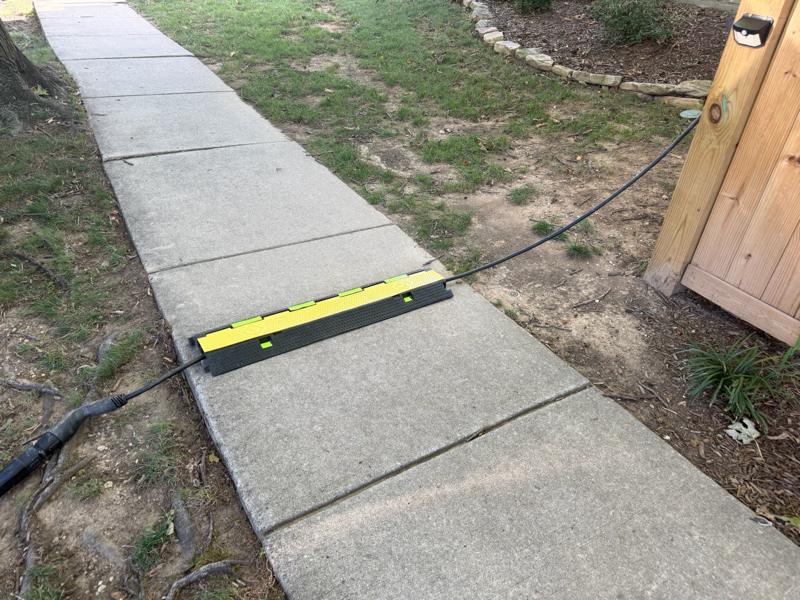
Today, practically speaking, you need a driveway. Thousands of Alexandria households — especially in the city's older rowhouse and townhouse neighborhoods — park on the street and have no lawful, practical way to charge a car from their own home. CurbsideALX is a researched, engineering-first proposal to fix that: let residents without driveways safely run a charging cable to the curb under an approved protective cover, the way Seattle and many other cities — including Washington, DC and, since December 2025, Fredericksburg, Virginia — already have.
Add your voice. Tell City Council: "I support the CurbsideALX proposal to allow residents without driveways to charge their cars." The form drafts the letter — short, medium, or detailed — and you send it from your own email in about two minutes.
✉ Email City Council — I support CurbsideALXNothing is sent or stored by this site; the letter opens as a draft in your own email app.
The problem: every way to charge assumes something Alexandria doesn't have
Most EV owners charge at home — the City itself cites research that roughly 75% of charging happens there. For a resident without a driveway, each alternative on offer today either excludes them or doesn't meaningfully exist yet:
The planning reality
Most people charge at home. Depending on public charging is a hypothesis about a world that does not yet exist — and the capacity analysis shows that building that world takes years and hundreds of ports. The sidewalk between a resident's panel and their car is the one piece of charging infrastructure Alexandria already owns.
What the numbers say
Alexandria's own 2020 EV Readiness Strategy identifies residents without driveways or garages as a charging use case; historic right-of-way practice (Alexandria Code §5-2-29 and related provisions) simply predates EVs. The research on this site quantifies what that gap costs a household — and what closing it is worth:
Figures from the cost analysis; assumptions and sensitivity ranges documented there.
The proposal: safe access now, better infrastructure as we build it
Alexandria does not have to choose between doing nothing and building perfect infrastructure immediately. The proposal is a ladder of lawful options that run at the same time: a safe protected crossing today, existing EV authority used creatively next, and a flush crossing delivered as an ordinary City service as the program matures.
Now
Approved removable protector
Allowed where site conditions and the published standard are met. The immediate tool and the fallback.
Immediate administrative option
Residential public-access license
A bridge under the 2026 EV encroachment amendment, if the City Attorney agrees it reaches homeowner-funded equipment. Explored and drafted here.
Preferred permanent service
City-installed flush crossing
A recessed channel delivered as an ordinary City service request, not a resident excavation permit.
Durable policy
Dedicated residential framework
A residential charging category in guidance or code, so access no longer depends on public availability. The drafted options.
These stages overlap. None waits on another to finish, and a household can move between them. Policy can be in motion while infrastructure improves.
Immediate fix — no permit program required
Adopt published guidance, the way Seattle and other cities — including Washington, DC — already have: residents without off-street parking may run a charging cable to the curb without a permit, provided they use whitelisted equipment — certified EVSE and an approved high-visibility cable protector — deployed only while actively charging. Zero applications to process, zero inspections to schedule, a clear standard to enforce against. If Council prefers the full administrative version — permits, inspections, insurance — that program is drafted too. Both options, with draft resolution language →
Long-term strategy — capacity where it actually scales
Treat home charging as the default wherever it can be safely enabled, invest public effort in DC fast charging (one fast port serves roughly nine times the drivers of a curbside L2 port), and use public L2 where cars naturally dwell — rather than as the substitute for home access. The capacity analysis →
The perfect sidewalk crossing should not become the enemy of the safe one
Vehicle purchases happen now, and a gasoline car bought because home charging looked impractical stays on the road for most of a decade. We can protect pedestrians and stop losing time: build the better crossing, and allow the safe one while we do. Why delay outlasts itself →
The core principle throughout: regulate outcomes, not prohibitions. The City already manages temporary encroachments on the right-of-way with engineering judgment — construction zones, moving pods, dumpsters, special events. The same framework can deliver safe pedestrian passage, certified electrical equipment, and responsible temporary use of the curb for a nightly residential charging scenario.
Top questions
Isn't this just legalizing extension cords across the sidewalk?
No — the opposite. Only certified charging equipment with the cable fully enclosed in an approved high-visibility protector, deployed while charging. Bare cords and household extension cords stay prohibited. Full answer →
What if someone trips?
The protector exists to prevent exactly that: flat, slip-resistant, beveled, safety-yellow — the same device that carries foot traffic in stadiums daily. If an injury happened anyway, the resident's liability insurance responds, as with any residential encroachment the City already permits. Full answer →
Why not just build more public chargers instead?
Scale. Public L2 as the main answer means ~1,500 ports at just 25% EV adoption against a program capped at 60 — and it still costs a driver ~$5,700 a year in money and time. Home charging where it's safely feasible is the cheapest capacity the City can add. Full answer →
Can I legally do this today — and what do I risk?
Not under any clear rule — that's the gap. Current law runs through the courts (§ 1-1-7); the administrative penalty ladder Council debated was deferred. Either way, penalties attach to the absence of a standard, which is what the proposal fixes. Full answer →
More: all questions & answers, grouped for residents, neighbors, and City staff.
The proposal — let residents charge across the curb
Safe for pedestrians?
Temporary cable protectors should be evaluated as temporary pedestrian facilities — the framework the ADA, VDOT work-zone guidance, and Alexandria's own Maintenance-of-Traffic policy already use — not as permanent ADA infrastructure.
Read the analysis →Ramp or permanent channel?
The ~$300 removable ramp is the baseline; a flush recessed cable channel is the permanent option at a provisional $1,250–$2,250. Overhead arms and flat cables compared too.
Compare the options →Electrically safe?
Safety comes from certified EVSE (UL 2594, UL 2231, SAE J1772, NEC Article 625) — not from the charging level. Require certified equipment, not Level 1 only.
Read the analysis →Insurance that fits
Alexandria's own encroachment guidance uses $500,000 limits for residential encroachments, reserving $1M for commercial uses. A residential cable crossing belongs in the residential tier.
Read the analysis →What residents risk today
Two penalty tracks: current law's court-enforced §1-1-7 (up to $2,500 per proven offense, if it applies) and a proposed administrative ladder Council has deferred. Both punish the absence of a standard.
Read the analysis →Cities already doing it
Washington DC, Seattle, Portland, and Cambridge already allow residential across-sidewalk charging with cable covers — through published guidance or lightweight permits, without reported harm. Links to every program.
See the programs →The bigger picture — why public L2 isn't enough
What it costs a household
Home charging costs ~$1,128/yr all-in. Relying on public charging costs $3,600–$16,400/yr once travel and waiting time are valued — even under assumptions deliberately favorable to public charging.
Explore the model →What waiting costs the city
Public charging is a $612–$972/yr cash premium plus a 67–78-hour annual time tax — and each year of policy delay locks in ~215 gasoline purchases for most of a decade. Two interactive models.
Test the assumptions →What public L2 costs to provide
A commercial operator's electricity alone costs ~16¢/kWh delivered; break-even retail is ~$0.30–$0.52/kWh. The break-even analysis grounds the cost model and shows what makes the City's own program succeed.
Read the analysis →Ports, capacity & fast charging
An L2-first strategy needs ~1,500 ports at just 25% EV adoption; the fast-charging equivalent is ~160 — and cross-curb access halves it again. Interactive port-count model included.
Explore the model →The story
The story so far
January to October, in order: the house, the notices, twenty-seven reports, eight signs, a vote, two meetings with the City, a surrender, and a unanimous commission letter.
Read the timeline →The signs we've posted
An open letter, a fine warning and neighborhood vote board, a comment card, and the trench-drain fix we'd rather build — the signs posted at one Alexandria rowhouse while this proposal was written. All downloadable.
See the signs →The neighborhood vote
We put a vote board on the sign and asked passersby what a household without a driveway should do. At 100 votes: 67 for kindness, 18 for a driveway, 15 for a fast charger — and a third of the block willing to spend thousands of someone else's dollars.
Read the results →The supercharger test
We gave up home charging and timed the alternative: 90 minutes door to door, $16 for 100 miles — 16¢ a mile against 3.9¢ in a driveway, and 80 hours a year in a parking lot.
Read the field test →The Scofflaw Dossier
What happens today, without a permit pathway? One resident's cable ramp generated twenty-seven 311 reports in 107 days — and zero injuries. A satirical exhibit, built from public records.
Open the dossier →Where to start
- Council & staff: The Proposal — the requested action, eligibility, permit conditions, and evaluation metrics.
- Engineers & advocates: Proposed Engineering Standards — the performance-based standards the proposal recommends.
- Residents & neighbors: Questions & answers — what you can do today, what it costs, trips, snow, wheelchairs, night visibility.